
Found your dream home before selling your current one?
It’s one of the most common — and most stressful — positions a home buyer can find themselves in. You’ve found the property you want, but your current home either hasn’t hit the market yet or selling it fast enough to line up with your new purchase would mean potentially accepting a lower price than you’d like.
A bridging loan solves this problem. It lets you buy your next home before your current one sells, without scrambling to line up settlement dates or moving into temporary rental accommodation in between if you sell first.
In a competitive market, that speed and certainty can be the difference between securing the right property and missing out on it.
How does a bridging loan actually work?
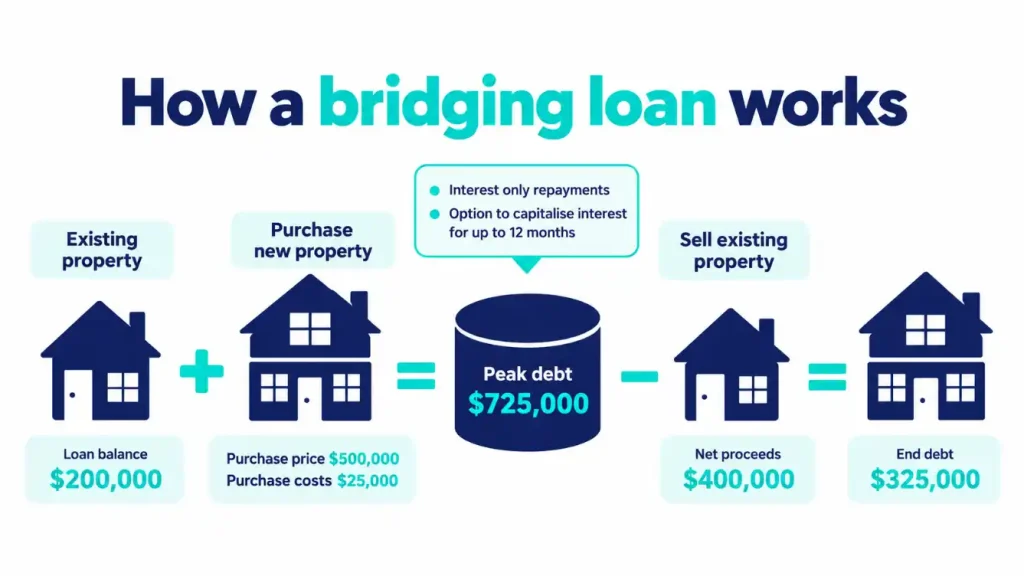
With a bridging loan, you take out additional borrowings to settle on a new property — and your existing loan stays as is or can be rolled into the total bridging loan. The lender will take a 1st mortgage over both properties to secure the existing and new bridging loan amounts.
The bridging period will usually be for a maximum of 6 to 12 months.
Here’s the terminology broken down:
Peak debt
The total you owe during the bridging period: your existing loan, plus the new property’s purchase price, plus costs like stamp duty less any contribution you are making.
End debt
The loan amount left once your old property sells and the net proceeds are used to pay down the peak debt. This becomes your ongoing, standard home loan.
Bridging debt
The Peak debt minus the End debt.
Accrued interest
Interest added to the bridging loan balance each month during the bridging period where no repayments are required.
Peak LVR
The total debt required expressed as percentage of the combined values of both properties. Generally, can’t exceed 80%.
End LVR
The end debt amount expressed as percentage of the value of the remaining property after the sale of the existing one. Generally, can’t exceed 80%.
There are two main types of ways bridging loans are offered by lenders. One method requires repayments on the peak debt during the bridging period and one method where interest accrues on the bridging debt until the existing property is sold.
Likewise, there are two different ways lenders generally assess the serviceability of a bridging loan. The lenders who allow interest to accrue on the bridging portion of the loan usually will just assess your ability to afford the end debt. While the lenders who require repayment on the total peak debt will want to test servicing on the total peak debt. In practice most people can not service the peak debt on their incomes so lenders will allow the shortfall in servicing to be covered by cash reserves.
A worked example
Say you have $600,000 remaining on your current home, which is valued at $1,500,000. You’ve just listed it for sale, and you’ve found your next family home for $2,000,000. To secure it without waiting for your current home to sell, you take out a bridging loan.
Setting up the peak debt
- Bridging loan portion = $2,100,000 ($2,000,000 purchase + $100,000 costs).
- Peak Debt = $2,700,000 ($600,000 current loan + $2,100,000 bridging loan).
- End Debt = $1,200,000 ($2,700,000 peak debt – $1,500,000 sale price).
Interest on the bridging portion comes to roughly $12,250 per month (7% pa) — this is the real cost of using this strategy, though in a rising market the numbers can work strongly in your favour.
Some lenders would allow this amount to be added to the bridging loan i.e. interest accrues each month.
Alternatively, you would either need to be able to show you can service this high interest burden each month OR have cash reserves sufficient to cover any serviceability shortfall for 6 or 12 months deepening on lender.
When your home sells, the full proceeds go toward paying down the peak debt.
Checking the loan-to-value ratios (LVRs)
Most lenders want peak and end debt LVRs under 70% (a handful will stretch to 80%, with exceptions).
- Peak debt LVR: $2,700,000 ÷ $3,500,000 (combined value of both properties) = 77.14%
- End debt LVR: $1,200,000 ÷ $2,000,000 (new property value) = 60%
In this scenario, the peak debt LVR is high enough that only a small handful of lenders would consider it — which is exactly the kind of detail a broker needs to work through with you before you commit to buying.
Pros and cons of bridging finance
- Buy your next home without waiting to sell.
- No need to rent in between, or coordinate two settlement dates.
- Freedom to negotiate a good price on your sale rather than a rushed one.
- Move quickly in a competitive market.
- You're carrying two mortgages, even if only one is fully serviced.
- Interest accrues on the bridging portion, a real cost if the sale takes longer than expected.
- Fewer lenders offer true bridging products, and policies vary widely.
- You generally need substantial equity to qualify.

What do lenders look for?
Every lender treats bridging finance differently, which is precisely why this is a space where a broker earns their keep:
- Equity in your current home. As a rule of thumb, we suggest having at least 50% equity in your existing property before considering a bridging loan.
- A realistic sale plan. Some lenders want your property already listed or under contract; others are more flexible if you have a clear plan and timeframe.
- LVR limits. Most lenders cap peak and end debt at 70–80% loan-to-value, as shown in the example above.
- How serviceability is assessed. This is the detail that catches people out — some lenders assess your ability to service only the end debt (a true bridging loan), while others assess the entire peak debt, which is a much higher bar but can be overcome if you have some extra cash in reserve.
Alternatives worth considering
A bridging loan isn’t the only way to manage a purchase-before-sale situation. Depending on your equity position and how confident you are about your sale timeline, it may be worth exploring:
- A longer settlement on the property you’re buying, giving your current home more time to sell.
- A “subject to sale” condition on your purchase, so the deal only proceeds once your existing home sells.
- A “quasi” bridging arrangement, which we can sometimes structure to be more cost-effective than a true bridging loan, depending on your circumstances.
Why work with a broker on this
Bridging finance is one of the more technical corners of home lending — every lender has its own rules on what gets assessed, how interest is treated, and what LVR they’ll accept. Getting it wrong can mean paying more than you need to, or missing out on a lender that would have said yes when your first choice said no.
We’ll run the numbers on your specific scenario, check which lenders would actually consider your position, and help you weigh a bridging loan against the alternatives — before you’ve committed to buying.
Give us a call to talk through your bridging options — ideally before you’ve made an offer.