

Investing in property isn’t just about getting one loan approved — it’s about getting the right loans, structured the right way, so that you can grow your wealth without losing sleep.
Most property investors don’t run into hurdles at their first purchase. They run into roadblocks at their second property or when they want to upgrade their owner occupier property.
This page pulls together the key structural decisions every property investor should understand, with links through to a dedicated page on each. If you only read one thing before your next purchase, make it the section on loan structuring — it affects almost everything else.
Getting the structure right, before the transaction
We don’t just look at the loan you need today. We look at where you want your portfolio to end up, and map out the likely sequence of purchases, loans, and lenders to get you there — because the order you use lenders in, and how you structure each loan, can make or break your ability to keep growing.
Three structural decisions matter most:
Whether your properties are cross-collateralised or stand-alone
This determines how much control you keep if something goes wrong, or if you simply want to sell.
How your lender assesses your overall servicing
Not all lenders view a multi-property portfolio the same way, and the difference in borrowing capacity between lenders can be substantial.
Whether you're borrowing as an individual, through a trust, or through another structure
This affects asset protection, tax treatment, and which lenders will even consider your application.
1. Property Investors: the four problems we solve most often
Most of the issues we see investors run into fall into a handful of categories:

Incorrectly structured loans — properties and loans all tied together with one lender (see cross-collateralisation below), which can trap you when you most need flexibility.

Lender servicing constraints — every lender calculates your borrowing capacity differently, and the gap between the most and least generous lender can be significant, especially once you hold multiple properties.

Interest-only expiry — deciding whether to renew an interest-only period or switch to principal & interest is a cash-flow-versus-total-cost decision that depends on your broader strategy.

Complex structures — loans to companies, family trusts, unit trusts, hybrid trusts, and SMSFs each come with their own lender restrictions, and getting this wrong before you commit to a structure can limit your borrowing later.
2. Cross-collateralisation vs. standalone security
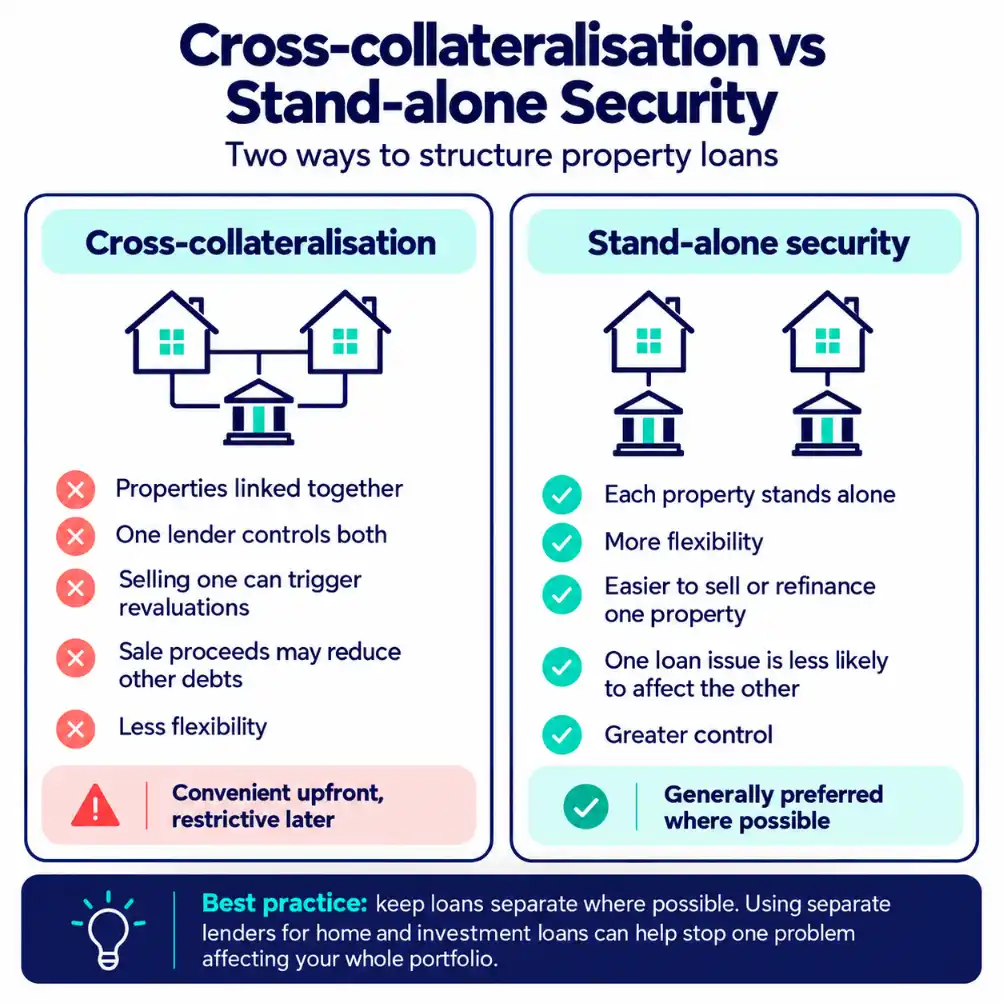
When you buy an investment property, you can either cross-collateralise it with your existing property (using the combined equity as security for both loans) or keep each property as stand-alone security with its own loan.
Cross-collateralisation feels convenient upfront, but it hands the lender control over all your linked properties — if you ever want to sell one, the lender can require the others to be revalued, demand net sale proceeds go toward other debts, or even block the sale altogether if they’re not satisfied with your remaining position. We generally recommend stand-alone structures wherever possible, and using separate lenders for your home and your investment loans, so that a problem with one loan can’t cascade into your entire portfolio.
3. Borrowing through a trust
Trusts were traditionally used by investors for two reasons: asset protection (trust assets are generally shielded from the personal liabilities of beneficiaries) and tax benefits (including CGT treatment and flexibility in distributing income). The third reason was for increased borrowing capacity, but this has mostly been shut down now.
Many bank and non-bank lenders have stopped lending to trusts in the residential loan space after it became apparent in early 2026 that some brokers and buyers’ agents had been spruiking using trusts with company trustees to get what they called “unlimited” borrowing capacity. A loophole in some banks policies meant the bank would effectively ignore debts held in other trusts that they were not lending to even if the same people were behind all the trusts and were in effect servicing guarantors for all the trust loans.
Some bank lenders are still offering trust loans for existing mortgage customers and through their business banking channels and many non-bank lenders are still open for business in this space.
Not all trust structures are equal when it comes to borrowing:
Family (discretionary) trusts offer the widest range of lending options and are the most common choice for investors.
Unit trusts are commonly used where non-family members are involved but come with fewer lenders and less asset protection.
SMSF trusts can no longer borrow to invest in residential property but loans can be refinanced and commercial property loans are still allowed.
Hybrid trusts are the hardest to finance — very few lenders will touch them at all.
Many brokers and bank staff aren’t across trust lending, which can mean being pushed into commercial rates and fees unnecessarily. It pays to get advice before you commit to a structure.
4. Development finance
If you are considering building a duplex or 3 or 4 townhouses, we can often accommodate those sorts of projects under a residential loan product if servicing (including future rents) is sufficient.
If your proposal doesn’t quite service under a standard residential bank loan or the development is for more than 4 dwellings, we can look at commercial finance options for you as well as private funding.
We can help guide you with the most cost-effective way to get your project started and completed. Private capital lenders and a few of the larger non-bank lenders specialise is medium sized developments (think 4-10 townhouse range for example). In this space bank finance is very hard to get if you are not a well-established developer already.
Non-bank and private lenders also take a different approach than traditional finance, often lending against the Gross Realisation Value (GRV) of the completed project (typically up to 65–70%) rather than the traditional hard-cost method (80% of land + construction cost). This can mean no pre-sale requirement, faster starts, and less developer equity tied up.
5. Investment loans at high LVR’s including 95% LVR
95% investment loans are back on the market, with major banks re-entering this space in 2025–2026 after years of it being effectively unavailable.
Rates tend to run higher than a standard investment loan, and Lenders Mortgage Insurance still applies — with the cost varying significantly between lenders and mortgage insurers, sometimes by thousands of dollars on the same loan size.
We also have access to 98% LVR loans through a select number of non-bank lenders at cheaper rates than the banks can offer at 95% LVR.
Many investors still weigh a 95% loan against a 90% loan, which offers similar benefits — avoiding cross-collateralisation, keeping deposit contribution low — but at a much lower LMI cost and lower interest rate.
Frequently Asked Questions
FAQs
Can you live in your investment property?
Yes, you can move into your investment property but depending on length of time you stay, if its short term or more permanent you should let your lender know and also the ATO as there are some tax implications to take into consideration.
Do you charge fees for home and investment loans?
Mortgage Experts doesn’t normally charge any fees for arranging residential home or investment loans. In the vast majority of situations this is not required as lenders pay us commissions for introducing your business to them. We do on occasion deal with non panel lenders who may not pay commissions. In the case that this type of lender is your best option we would negotiate a fee for service with you.
We also have a commission clawback policy. Most lenders will fully or partially “claw back” the upfront commission they have paid us if a clients loan is repaid in full within the first 1 – 2 years of it’s origination. This would usually happen if the property is sold or the loan refinanced to another lender. To compensate us for our out of pocket expenses we will generally charge a minimum fee of $550 if a loan we have arranged is paid back within the lender’s claw back period. If you are undertaking further borrowings through us at the time you current loan is repaid or within 3 months of it being repaid we will waive or refund this fee.
Any fee that we negotiate with you (remembering that for the vast majority of our clients no fees will be payable) will be disclosed to you in writing to you before your loan is submitted to a lender.
How do I find the fair market value of my home?
Getting a comparable market analysis from an active local real estate agent who will compare your home to all the properties in the same neighbourhood that sold in the previous six months and were roughly the same age, size, and condition as yours is a great way to determine the fair market value of your home.
How do I prove what income is generated from my rental property?
Your mortgage broker will most likely ask you for proof of the income generated by your investment property. These can be evidenced via your last rental statement, a property rental appraisal from a real estate agent or a full property valuation.
How is gross rental yield calculated?
Here’s how to calculate gross rental yield:
- Sum up your total annual rent that you would charge a tenant
- Divide your annual rent by the value of the property
- Multiply that figure by 100 to get the percentage of your gross rental yield
How long do you have to live in a house to avoid capital gains tax in Australia?
You may be exempt from capital gains tax if you live in your property for at least six months after purchasing it. However, you must be able to show that it is your principal residence in this case. If you’ve bought and sold a property within a 12-month period, your capital gain is simply added to your income – easy. But if you’ve owned your property for longer than 12 months before selling, there are some calculations to do.
Is Lenders Mortgage insurance a one-off payment?
LMI is a one-off insurance premium which is payable by the borrower and protects the lender against the loss it may incur if the borrower is unable to repay their home loan. So, how much is lenders insurance mortgage? This depends on where you borrow, your lender and the size of your deposit. Your broker can show how to calculate Mortgage Insurance for your circumstances.
Is rental yield important?
Understanding rental yields is important for real estate investors as it helps determine what the ongoing yield of a potential investment is and whether it is in line with the overall investment objectives. Typically, the driving force behind purchasing an investment property is to make more money. If you’re a property investor, rental yield can give you an idea of how much money you’re earning each year on your property.
There are 2 ways to calculate rental yield:
- Gross rental yield – is the simplest of the two ways, as it only considers the rental income and the value of the property. You divide the total annual rental income by the property value, then times by 100. Rental income / property value x 100
- Net rental yield – is more complex as you need to include any property fees and expenses. Add up all the fees and expenses, subtract from the annual rent, divide by the property value and multiply by 100. Annual rental income – property expenses / property value x 100.
What’s a good rental yield?
In Australia a good gross rental yield is around 5-8% and a good net rental yield of 4.5% or higher is considered strong.
Is yield a good investment?
Understanding how property yield works gives you a better idea of the ongoing return you will earn on your investment. It can also be helpful when it comes time to review the rent on an investment property. When you know the rental yield of a property, you’re also better placed to understand if it is the right place for your investment goals, or if you could earn a higher rental yield with a different property or by investing in another suburb.
What classifies as owner-occupied?
When you’re buying a home or apartment you intend to live in, it’s called an owner-occupied property.
What documentation does a lender need if I am using my superannuation income?
Depending on lender you will need to evidence this with account credits, Super fund statements, your tax return and letter from a financial planner or advisor detailing regular repayments from your superannuation investment.
What is a Self Managed Super Fund (SMSF) Loan?
It’s a way to buy an investment property in a self-managed super fund. Any earnings on the investment whether its rental income or capital gains end up in the superannuation fund to help increase any savings for retirement.
What qualifies as an investment property?
An investment property is real estate purchased to generate income through rental income or appreciation.
Why do investors use interest-only loans?
Investors tend to use interest only loans to refrain from needing to repay capital, the monthly payments are lower than for principal-plus-interest loans. This helps to maximise cash flow while continuing to benefit from capital growth.