

What is “cross collateralised” security?
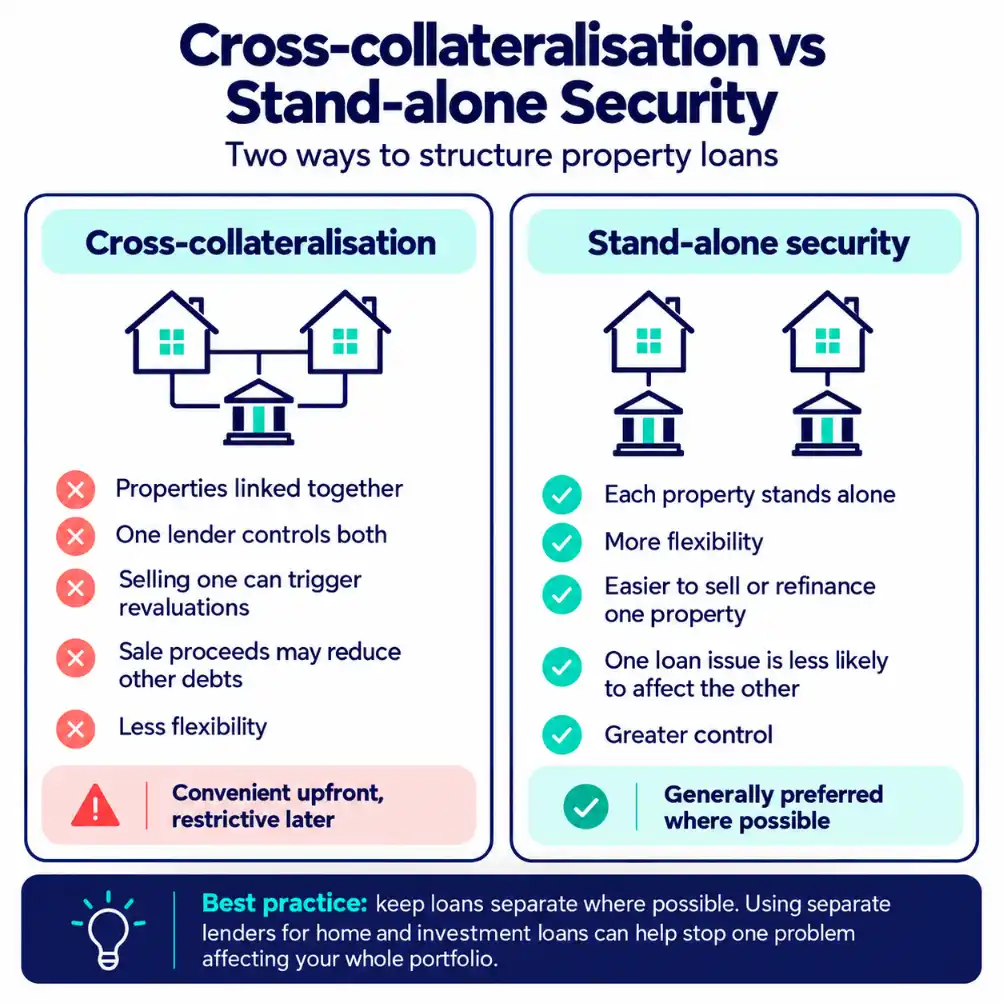
Cross collateralisation is the term used to describe when two or more properties linked together to secure one or more loans by the same lender. When you have loans cross collateralised, the lender in question is securing the aggregate of all your borrowings with the aggregate of all your security.
If an investor wanted to acquire a property using the cross collateralisation method, they could structure as per the following example.
Say you have a home loan of $400,000 which is secured by your family home worth $800,000. Potentially you could use the equity in your home as additional security and purchase an investment property for say $500,000 while borrowing the entire purchase price and the associated costs such as stamp duty. So say a total loan of $530,000.
In aggregate you would have $930,000 in loans secured by $1,300,000 worth of property. Expressed as a loan to value ratio (LVR) it would be 71% which would be an acceptable level for all lenders
Family home and new investment property used as security for both loans
What is “stand alone” security?
Having a stand alone security means a loan or loans are secured solely by one property. To use the stand alone method to acquire additional properties, an investor could structure as follows (using the same figures from above).
Family home as stand alone security
Investment property as stand alone security
The funds to complete the purchase, i.e. the difference between the loan ($400,000) and purchase price ($500,000), would come from the $130,000 loan secured against the family home. Costs such as stamp duty would also come from these funds.
Stand Alone or Cross Collateralisation?
When the stand alone structure is the best option
We always recommend that our clients do the stand-alone method if possible rather than cross collateralisation. The reason being that untangling a series of crossed collateralised properties can be very difficult. It can also mean the borrower loses control of their affairs and can expose them to unnecessary risk.
As an example, say an investor has 5 properties all tied together as security for various loans and decided to sell one of their properties. Lenders can require the following to happen.
- The other 4 remaining properties would have to be valued to see if the security for the remaining loans will be sufficient. If it wasn’t, the lender can demand all sale proceeds be used to reduce the overall debt. In extreme cases a lender may even not allow the sale to go through.
- Some lenders require a full reassessment of a borrower’s financial position to see if they can still afford the remaining loans. This can come at an inconvenient time for the borrower. If the remaining loans are not deemed affordable by the lender they can as above demand the entire sale proceeds are used to reduce their overall debt level. In extreme cases, if the lender takes the entire sales proceeds and they are still NOT satisfied that the remaining loans fit within their policy, it may trigger a default. In this case a lender could force a borrower to repay all their loans immediately. In practice this would mean having to liquidate their entire property holdings, including possibly the family home, or repay the debt in full by refinancing to another lender (which might not be possible).
- Most lenders will require new loan and mortgage documents to be issued. While this in itself is no big deal it can be a hassle!
By keeping their properties stand alone and not cross collateralised a borrower can sell any of their properties and can pay out only the loan secured by that property. This is without any dictation from the lender regarding overall debt and other properties. There is no need for valuations or reassessment of your financial position with the lender. Most importantly, the investor dictates what happens to net sale proceeds.
Won’t I end up with lots of loans?
Possibly yes but it’s still worth the extra administrative efforts. One option for investors to consider is a line of credit facility secured by the property with the most equity. They can then use this for multiple deposits on different property purchases without the cross collateralisation of the properties.
When stand alone is not the best option
Occasionally the convenience or practicality of cross-collateralisation outweighs its pit falls. For example, when an investor does not have sufficient equity in a single property to make up the required deposit. They may have enough equity over a number of properties but not want multiple loans. In that case “crossing” the properties might be the best option.
What are “all monies” mortgages?
“All monies” is the term that refers to the fact that many mortgages do not relate to a specific loan amount advanced, but to all monies owed by a borrower to the lender.
Even if an investor chooses to use the stand-alone method to structure their loans, if all their mortgages are with the same lender they are still exposed to the “all monies” clause if something goes wrong. The best protection from this risk is to have your properties and loans with different lenders. Pros and cons below.
Spreading your lender exposure - Pros and Cons
- Most lenders offer better interest rate discounts for larger overall loan sizes.
- Simpler banking, one login and one relationship to manage.
- Easier to run a cash-out application and a pre-approval together, since the same credit assessor can assess both loans at once.
- If you default, the lender can enforce their rights under the mortgage and force the sale of that property to repay the loan.
- Under an "all monies" clause, they can force the sale of all your mortgaged properties to repay all your loans, even if you only defaulted on one.
- With everything at one lender, there's no competing lender to slow their actions down, or let you choose which loan to keep servicing to quarantine an asset.
Having all your loans with one lender can have some advantages namely 1) most lenders offer better interest rate discounts for larger your loan sizes and 2) you retain simplicity in your banking with just one net banking log in and relationship and 3) often it is an easier proposition to to do a cash out loan application for the deposit and a pre approval application for the investment property purchase with the same lender so the two loans can be assessed together by the same credit assessor.
The disadvantages only become evident if you get into financial trouble. In a loan default situation a lender can enforce their rights under the mortgage and force the sale of your property to repay their loan. They can also force you to sell ALL your property assets to repay all their loans under their all monies clause even if you had defaulted on just one of your loans. However if you have other assets mortgaged to different lenders having competing lenders could delay their actions. You could even choose which loan / asset / lender to not default on if you had reduced capacity to repay only one of your loans for example that way effectively quarantining that assets from the other lender.
So in summary if you have multiple properties and multiple loans and you have more than a certain amount with one lender we recommend you diversify and have at least 2 lenders. It may be easier to have all your loans with one lender but if you ever get into financial trouble it will be in your favour to have two or more lenders. A good strategy would be to have one lender for your home loan and another for all your investment loans.
Like many things things to do with borrowing money it is a decision to weigh up based on your own preferences and risk tolerance.